
How Payment Tokenization Improves Checkout Performance
August 20, 2026
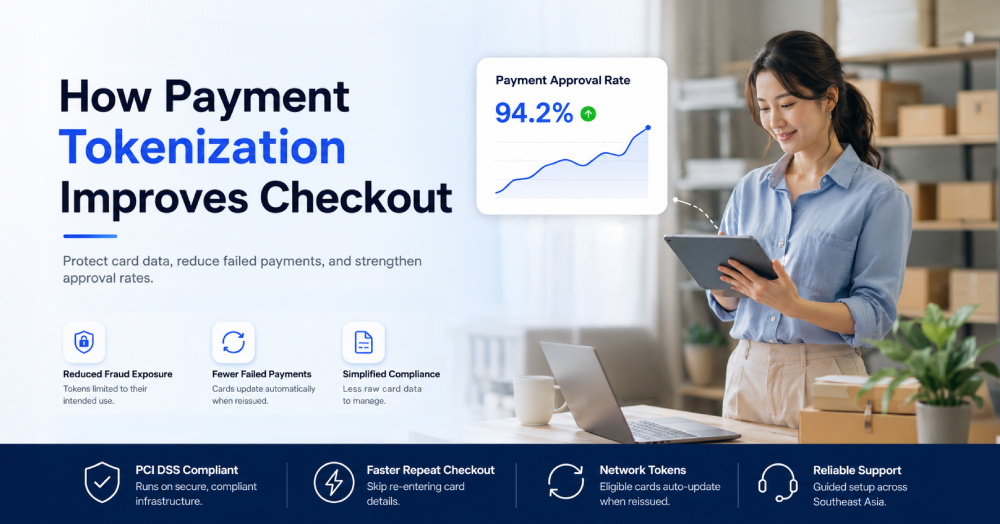
Payment tokenization replaces sensitive card details with secure digital tokens—protecting stored credentials, speeding up repeat payments and cutting down on the payment failures that come from outdated card information.
For years, tokenization sat in the security and compliance bucket. That's changing. A June 2026 PYMNTS feature documents how merchants are now treating it as a checkout-performance strategy—one that can improve authorization performance, support recurring billing and create a smoother payment experience.
For any business processing repeat or recurring payments, that shift matters. It's the difference between a customer relationship interrupted by a routine card update and one that continues without friction.
In brief: Tokenization protects card credentials, speeds up repeat checkout and reduces payment interruptions caused by outdated cards. Network tokenization goes further by potentially improving authorization performance and helping eligible stored credentials remain current when cards change.
Fiuu Tokenization helps Southeast Asian merchants securely store tokenized payment credentials for faster repeat payments and recurring-payment use cases across supported payment environments.
Key Takeaways
- Payment tokenization replaces card details with secure digital tokens, protecting stored credentials and reducing merchant exposure to raw card data.
- A June 2026 PYMNTS feature reports that merchants are increasingly treating tokenization as a checkout-performance strategy rather than just a security and compliance measure.
- Network tokens can support stronger authorization performance—Visa reports a 4.6% global uplift in approval rates for card-not-present network-token transactions.
- Network tokenization can also reduce fraud exposure, with Visa reporting an average 30% reduction in online fraud compared with PAN-based transactions.
- Fiuu Tokenization runs on PCI DSS-compliant infrastructure and can connect with Fiuu's Recurring Payment capabilities, subject to eligibility and integration requirements.
What Is Payment Tokenization?
Payment tokenization replaces a customer's primary account number—the 16-digit card number—with a unique digital token.
The token stands in for the card during authorized transactions. The original card details remain protected in a secure token vault, reducing the merchant's direct exposure to sensitive payment data.
When the customer returns, the token is used to process the payment. There is no need to re-enter the full card details, creating a faster and more secure repeat checkout.
Why Do Failed Payments Matter to Merchants?
A failed payment rarely stays contained to one transaction. It can trigger checkout abandonment, interrupt a subscription, delay revenue and leave the customer with a worse experience than they expected.
For recurring-payment businesses, outdated card credentials are a common cause of involuntary churn. The customer may still want the service, but the payment fails because the card on file expired or was reissued.
This is where network tokens can support payment continuity. Eligible tokens may be updated automatically when the underlying card changes, reducing the need for customers to manually update their stored card details.
How Does Tokenization Improve Checkout Performance?
1. Potentially Higher Payment Approval Rates
Network tokens can provide issuing banks with richer, more current transaction context. This supports more informed authorization decisions and may reduce unnecessary declines involving legitimate transactions.
Visa reports a 4.6% uplift in authorization rates globally for its card-not-present network-token transactions, compared with transactions using primary account numbers. That's a global average—individual results depend on issuer mix, market and transaction profile—but on meaningful volume, even a modest improvement can translate into additional revenue.
2. Better Recurring-Payment Continuity
Expired or reissued cards interrupt subscriptions even when the customer has no intention of cancelling.
Eligible network tokens may be updated automatically when the underlying card changes, subject to the card network, issuer and merchant configuration. Where this applies, it can help reduce a common and preventable cause of recurring-payment failure.
This matters most for subscription businesses, digital platforms, membership services and anyone else collecting repeat payments on a schedule.
3. Faster Repeat Checkout
Returning customers skip re-entering their full card details entirely. That alone removes real friction from the repeat-purchase flow.
Additional authentication—CVV, OTP or another security check—may still be required depending on the transaction and payment setup, so this is not necessarily a fully invisible checkout. However, it remains faster than entering complete card details again and can help reduce friction during repeat purchases.
4. Reduced Fraud Exposure
Tokens are generally restricted to the payment context for which they were issued. A properly configured token therefore has limited value outside its intended environment, unlike a raw card number that may be misused more broadly if compromised.
Visa reports that token-based transactions deliver an average 30% reduction in online fraud compared with PAN-based transactions. Individual merchant results may vary, but the findings demonstrate that tokenization can provide security benefits beyond basic compliance.
5. Simplified PCI DSS Compliance
Tokenization reduces the amount of sensitive cardholder data merchant systems need to handle or store. Less raw card data within the merchant environment can help simplify PCI DSS compliance, reduce security exposure and lower the operational burden of protecting payment information.
Payment Tokens vs Network Tokens: What's the Difference?
Not all payment tokens offer the same capabilities.
| Capability | Payment / vault token | Network token |
| Replaces sensitive card details | Yes | Yes |
| Supports stored-card payments | Yes | Yes |
| Reduces exposure to raw card data | Yes | Yes |
| Updates when the underlying card changes | Depends on the solution | Available for eligible credentials |
| Provides richer authorization context | Not inherently | Typically |
| May improve authorization performance | Depends on the setup | Potentially |
A payment or vault token typically replaces card information stored with a payment provider. A network token is issued through a card network and may provide additional capabilities, such as automatic credential updates and enhanced transaction context that can support stronger authorization performance.
Understanding the difference helps merchants choose a setup that supports both payment security and checkout performance.
What Should Merchants Look for in a Tokenization Provider?
The right tokenization setup should do more than protect card data—it should support how the business operates and grows. Merchants should evaluate:
- Token capabilities: Payment/vault tokens, network tokens, or both
- Recurring-payment support: Can tokenized credentials handle scheduled and repeat billing
- Credential updates: Are eligible card changes reflected automatically at the network level
- Regional availability: Which countries, card networks, issuers and channels are actually covered
- Integration requirements: How it fits into your existing checkout and gateway setup
- Security and compliance: Whether the provider operates on PCI DSS-compliant infrastructure
These factors help merchants choose a provider that can support both current checkout needs and future business growth.
Why Choose Fiuu Tokenization?
Fiuu Tokenization replaces sensitive card credentials with secure tokens that can be used for eligible subsequent payments.
After a customer's first authorized transaction, their payment credentials are tokenized and securely stored. On their next visit, the token retrieves what's needed to process payment, so there is no need to re-enter the full card details.
This helps merchants provide:
- Faster repeat checkout
- More secure stored credentials
- Support for recurring-payment use cases
- Reduced exposure to sensitive card data
- A smoother payment experience across supported web and mobile touchpoints
Fiuu runs on PCI DSS-compliant infrastructure, backed by more than two decades of payment experience across Southeast Asia. Merchants can also connect tokenization with Fiuu's wider Recurring Payment and online payment capabilities, subject to availability and integration requirements.
Available capabilities and integration requirements depend on the merchant's country, card network, issuer, payment channel and existing technical setup. Fiuu can recommend an appropriate configuration based on the merchant's specific use case.
Ready to improve repeat checkout? Talk to the Fiuu team about a tokenization setup suited to your business model, market and payment volume.
Who Can Benefit From Payment Tokenization?
Payment tokenization is particularly useful for businesses that process repeat or recurring card payments, including:
- Subscription and SaaS businesses
- E-commerce platforms
- Online marketplaces
- Membership and loyalty programmes
- Digital content and service providers
- Mobile applications
- Regional businesses serving returning customers
For these merchants, tokenization does more than protect payment credentials—it can help protect recurring revenue, reduce repeat-checkout friction and strengthen long-term customer relationships.
Tokenization Is More Than a Security Feature
Tokenization still does its original job—protecting card credentials. But that's no longer the whole story.
Faster repeat checkout, more reliable stored credentials and potentially stronger authorization performance can turn tokenization from a compliance measure into a valuable part of a merchant's revenue strategy. For businesses operating across Southeast Asia, even small gains in successful-payment rates and payment continuity can become meaningful at scale.
Sign up as a Fiuu merchant or contact [email protected] to explore a tokenization setup suited to your business model, market and payment flow.
Tokenization capabilities, network-token eligibility, authorization outcomes and integration requirements are subject to merchant eligibility, card network and issuer participation, and applicable market regulations.
Frequently Asked Questions
-
What Is Payment Tokenization?
Payment tokenization replaces sensitive card information with a unique digital token. The token is used for authorized payments while the original card details stay protected in a secure token vault.
-
How Does Tokenization Improve Checkout Performance?
It speeds up repeat payments, removes the need to re-enter full card details, and can help reduce failures caused by outdated stored credentials. Network tokens may also improve authorization performance by giving issuers current credential and transaction information.
-
Is Tokenization the Same as Encryption?
No. Encryption scrambles card information into an unreadable format that can be restored with the right decryption key. Tokenization replaces the card number entirely with a separate reference value that has no meaningful connection to the original credential outside the tokenization system.
-
Can Tokenization Reduce Failed Recurring Payments?
Yes. Eligible network tokens may be updated automatically when an underlying card expires or is replaced, helping reduce recurring-payment failures caused by outdated credentials—though payments can still fail for other reasons.
-
Does Tokenization Improve Payment Approval Rates?
Network tokenization may improve payment approval rates by providing issuers with current credential information and better transaction context. Visa reports a 4.6% global authorization-rate uplift for its card-not-present network-token transactions compared with PAN-based transactions. Individual results vary by issuer, market, merchant and transaction mix.
-
Does Tokenization Help Reduce PCI DSS Scope?
Yes. Tokenization reduces the amount of sensitive cardholder data handled by merchant systems, which can help simplify PCI DSS compliance, lower security exposure and reduce the operational burden of protecting payment data.
-
Is Tokenization Only Useful for Subscription Businesses?
No. E-commerce platforms, marketplaces, mobile applications, loyalty programmes and other businesses serving returning customers can benefit from the same repeat-checkout and security advantages.
-
How Difficult Is Tokenization to Implement?
It depends on the merchant's existing payment setup. For merchants already using a compatible payment gateway, tokenization may require API and checkout-flow changes rather than a complete reintegration. Fiuu can recommend the appropriate setup for the merchant's market and use case.
Related Posts



Your one-stop payment partner for business growth.
Sign Up
Comprehensive Payment Channels
Unlock over 110 major payment methods across Southeast Asia.

One Integration, One Platform
Enables business to accept local and cross-border payments in Southeast Asia.

Seamless, Easy, and Instant
Sign up with digital on-boarding and start accepting payment within minutes.